Why You Feel Like You’re Doing Everything
If you feel like you’re the one keeping track of everything…
even when your partner is “helping”…
you’re not imagining it.
You’re carrying the mental load.
It’s the constant background tab in your brain:
what’s running low
what’s coming up
what still needs to be done
what no one else is thinking about yet
And it doesn’t shut off.
So even when you’re sitting down, you’re not actually resting.
And over time, that turns into something most couples don’t expect: Resentment.
Because one of you is holding the invisible weight of running the whole system.
If you’ve been feeling like the “default everything”… well hello there, this is for you.
For years, we (Chels + Mike) didn’t have language for this either.
We just knew we were:
tired
snappy
and quietly disappointed in each other more often than we wanted to admit
It wasn’t until we understood the mental load that things started to click.
Because the issue wasn’t just what we were doing.
It was everything we were carrying behind the scenes. Now we walk couples just like you through how to address the mental load as a team, not as one person drowning and the other offering a life jacket from time to time.
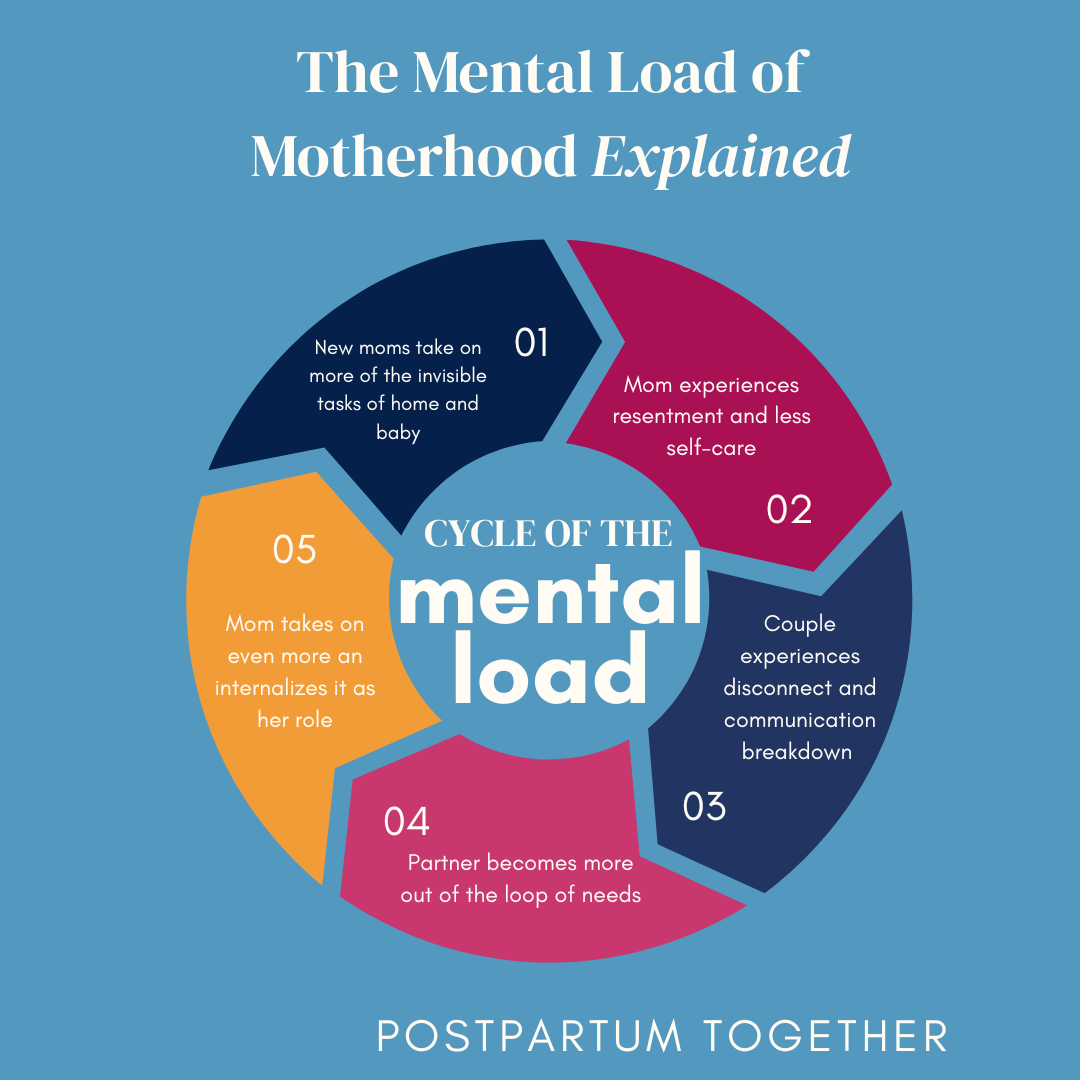
What Is the Mental Load? (Simple Definition)
The mental load is the invisible labor—the thinking, remembering, planning, organizing, and anticipating—that keeps a household and family running.
It’s not the doing.
It’s the thinking behind the doing.
It’s:
Remembering the diaper bag needs restocked
Noticing your child is about to outgrow their clothes
Scheduling doctor appointments
Planning meals
Keeping track of birthdays
Coordinating schedules
Thinking ahead about childcare, school forms, and holidays
No one sees it happening.
But if it stops happening, everything falls apart.
And in many families, one partner becomes the manager, while the other becomes the helper.
That management role?
That’s the mental load.
As the UCLA puts it, mental load typically refers to the behind-the-scenes, cognitive and emotional work needed to manage a household.
What Is the Mental Load in Motherhood?
The mental load in motherhood is the invisible responsibility of managing not just yourself, but everyone else’s life too.
Even if your partner is doing their fair share physically, you may still be the one:
Tracking doctor appointments
Remembering when the laundry detergent is low
Noticing when your child’s shoes no longer fit
Keeping birthdays and holidays on your radar
Signing permission slips
Scheduling childcare
Planning meals
Keeping track of nap schedules
Packing diaper bags
Researching sleep schedules
Buying the next size up in clothes
Planning holidays
Coordinating family schedules
This is why so many moms feel exhausted even when their partner says,
“Just tell me what to do and I’ll do it.”
Because now you’re not just doing the work.
You’re managing an employee.
And that dynamic gets exhausting fast.
Why It Feels So Hard to Break Out of the Mental Load
For a lot of moms, the hardest part isn’t just the workload—it’s not having the words for what’s happening.
You just know:
Your brain won’t slow down
You’re constantly thinking about what’s next
There’s no real “off” switch
You don’t even have space to think about yourself
It can feel like your brain is a browser with 497 tabs open at all times.
And underneath all of it is this quiet pressure:
If something falls through the cracks… it falls on you.
Not because your partner is a bad parent.
But because the responsibility has quietly defaulted to you.
And when you don’t have language for that, it’s really hard to change it.
Research shows that women are more likely to be responsible for “cognitive labor,” meaning the planning, organizing, and remembering required to run a household. This invisible work is strongly linked to burnout, resentment, and relationship dissatisfaction when it is not shared or acknowledged.
Mental Load List: Real-Life Examples
Here’s a look at what might be on your unspoken mental to-do list:
Household Management
Noticing when things run low (toilet paper, snacks, batteries)
Creating the grocery list
Remembering which meals the kids will actually eat
Parenting Tasks
Managing school calendars, permission slips, spirit week
Scheduling well-checks and vaccinations
Keeping up with shoe sizes, lunchbox needs, growth spurts
Relationship & Family Life
Planning date nights or babysitter arrangements
Remembering extended family birthdays
Organizing holiday plans
Daily Logistics
Coordinating pickups and drop-offs
Noticing upcoming schedule conflicts
Managing daily routines and “mental prep” for transitions
This is just the tip of the iceberg. And carrying this invisible list — without shared recognition — often leads to deep resentment.
Why the Mental Load Turns Into Resentment
Resentment doesn’t come from doing too many dishes.
It comes from feeling alone in the responsibility.
When one person is:
The planner
The reminder
The one who notices
The one who asks
And the other person is:
Waiting to be told
Helping but not initiating
Completing tasks but not owning them
You don’t have a chore imbalance.
You have a responsibility imbalance.
And here’s the part no one says out loud:
It’s really hard to feel attracted to someone you feel like you have to manage.
And it’s really hard to feel connected when you feel like their assistant.
That’s how couples slowly become roommates.
Why You Feel Like You’re Fighting Over “Nothing”
You’re not fighting over who does the dishes this very time.
You’re fighting about:
Being the only one who remembers the dishes
Being the only one who notices they need done
Being the only one who has to say something
So when something small happens, the reaction feels big.
Because it’s not about the moment.
It’s about the accumulation of responsibility.
This is what I hear all the time:
“I don’t mind doing things—I just hate being the one who has to think about them first.”
That’s the mental load.
And it creates something called preemptive resentment—
when you’re already frustrated before anything even happens, because you know how it’s going to go.
Why Your Partner Might Not See It
This part matters.
Because if you don’t understand this, it turns into blame instead of change.
Many partners genuinely don’t see the mental load because:
They weren’t raised to see it
They don’t feel the same consequences when things are missed
They believe “helping” is enough
This isn’t about someone being lazy.
It’s about operating from completely different awareness levels.
And once you see that, you can start to shift it together.
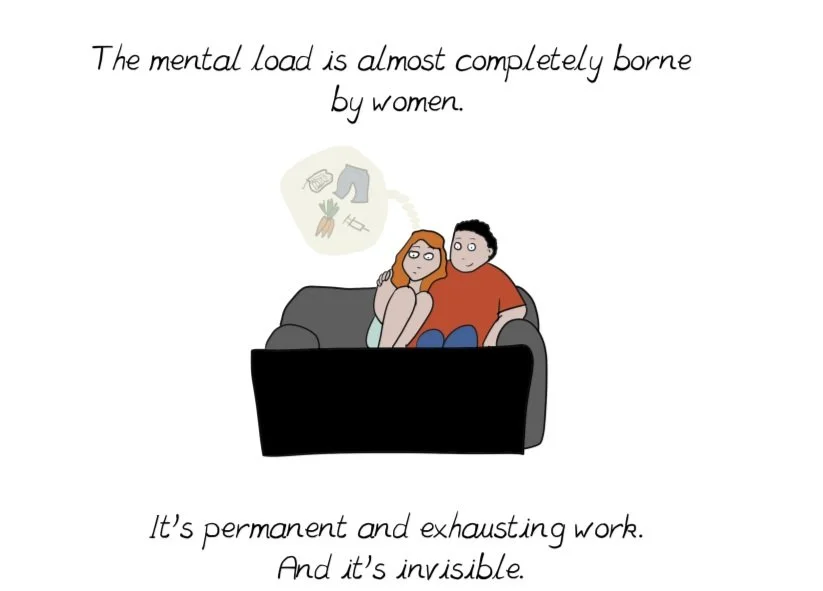
One of the most well-known visuals explaining the mental load is Emma’s comic “You Should’ve Asked.”It shows a mom doing all the thinking while her partner “waits to be asked.”
How to Ask for Help Without Creating More Tension
This is where a lot of couples get stuck.
They either:
Say nothing and build resentment
Or say everything in a way that turns into a fight
There’s a better way.
1. Start with appreciation
Not fake. Not forced. Just real acknowledgment.
“I really appreciate how you handle bedtime. That makes a difference.”
This lowers defensiveness immediately.
2. Use “I” statements
Instead of:
“You never help.”
Try:
“I’ve been feeling really overwhelmed, and I need more support.”
3. Be specific
“Help more” is unclear.
Try:
“Can you take over bath time on Tuesdays and Thursdays?”
or
“I need you to fully own groceries this week.”
4. Make it a team conversation
“This isn’t about blaming you. I want us to feel more balanced.”
5. Invite collaboration
“What would feel realistic for you to take on?”
This turns it into partnership—not pressure.
How to Start Sharing the Mental Load
Here’s what actually works:
Assign ownership, not tasks
Divide responsibilities by category (not one-off help)
Stop relying on reminders
Have weekly check-ins
Write everything down
Use systems instead of hoping it improves
Because this isn’t a communication issue alone.
It’s a structure issue.
A Simple Way to Start
If you’re reading this and thinking, “This is us,” start here:
Write down everything someone is responsible for thinking about
Decide who owns what (fully)
Have one honest conversation this week
Use tools that support the process
You don’t need to fix everything overnight.
You just need to stop pretending this isn’t happening.
Get the Mental Load List + Conversation Guide
If you’re ready to actually do something about this:
Use our Mental Load List + Conversation Guide to:
Make the invisible visible
See who’s carrying what
Start a real conversation
Move from “helper” to shared ownership
This is the exact tool we used—and now use with our clients.
Mental Load FAQ
What is the mental load in simple terms?
The mental load is the invisible work of remembering, planning, organizing, and managing a household.
Is the mental load the same as chores?
No. Chores are physical tasks. The mental load is the thinking behind them.
Why does the mental load fall on moms?
Social conditioning, default roles, and invisible expectations often place this responsibility on women.
How do I share the mental load with my partner?
Start by identifying all responsibilities (not just tasks), then divide ownership—not just execution.
If you want help navigating this in your own relationship—without it turning into another argument—that’s exactly what we do.
You don’t have to keep doing this alone.