Why Stay-At-Home Moms Need a Job Description
(And Why You’re So Exhausted Without One)
If you’ve ever felt like being a stay-at-home mom is a 24/7, never-ending job with no clear boundaries—you’re not wrong.
It’s diapers, meals, schedules, emotions, logistics… all blending together with no clear “start” or “stop.”
And if you’re honest, it can leave you feeling:
Overwhelmed
Resentful
Invisible
And somehow still like you’re “not doing enough”
That’s not because you’re failing.
It’s because you’re carrying a role that has no definition.
And that’s exactly why a job description changes everything.
What Stay-at-Home Moms Are Actually Doing All Day
Let’s make something clear:
You are not “just at home.”
You are:
Managing schedules, appointments, and routines
Planning meals and running household logistics
Anticipating needs before they happen
Holding emotional space for your kids
Often holding emotional space for your partner
Constantly tracking, adjusting, and deciding
Most of this work is invisible.
Which means:
It’s only noticed when it’s not done.
That’s the invisible load—and it’s a huge reason why so many stay-at-home moms feel exhausted.
The Invisible Load of Stay-at-Home Mom Life
The invisible load is the mental, emotional, and logistical work required to run a home.
It’s not just:
Doing laundry
Making meals
Cleaning
It’s:
Knowing when the laundry needs done
Deciding what meals to make
Remembering what needs cleaned and when
It’s the constant mental tabs open in your brain.
If you’ve ever thought:
“Why am I so tired when I’m home all day?”
This is why.
Studies estimates that stay-at-home moms can carry the equivalent of 98+ hours of work per week
That’s more than two full-time jobs.
And most of it goes unseen.
Why Stay-at-Home Moms Feel So Exhausted
It’s not just the workload.
It’s the lack of structure, recognition, and boundaries.
You don’t have:
Clear working hours
Defined responsibilities
Built-in breaks
Performance feedback
A sense of “done”
So your brain stays “on” all the time.
And over time, that leads to:
Burnout
Irritability
Disconnection
Feeling underappreciated
Self-doubt
Not because you’re weak.
Because you’re doing too much without support or clarity.
The Missing Piece: A Stay-at-Home Mom Job Description
Think about any other role you’ve had.
There was:
A job description
Clear expectations
Defined responsibilities
Boundaries around your time
Now compare that to being a stay-at-home mom.
There’s often:
No clear role
No boundaries
No shared understanding
No division between “your job” and “shared responsibilities”
That’s where the job description comes in.
It’s not about putting yourself in a box.
It’s about creating:
Clarity
Ownership
Teamwork
What a Job Description Actually Does
A stay-at-home mom job description helps you and your partner:
1. Create clarity
Instead of everything feeling like your responsibility, you define:
What falls under your role
What is shared
What needs to shift
2. Build real teamwork
Parenting stops being:
👉 “You handle everything, I help when asked”And becomes:
👉 “We each own parts of our family and home”3. Set boundaries around time
You define:
What happens during “working hours”
What happens after
When both of you are “on”
Because staying home does NOT mean being on the clock 24/7.
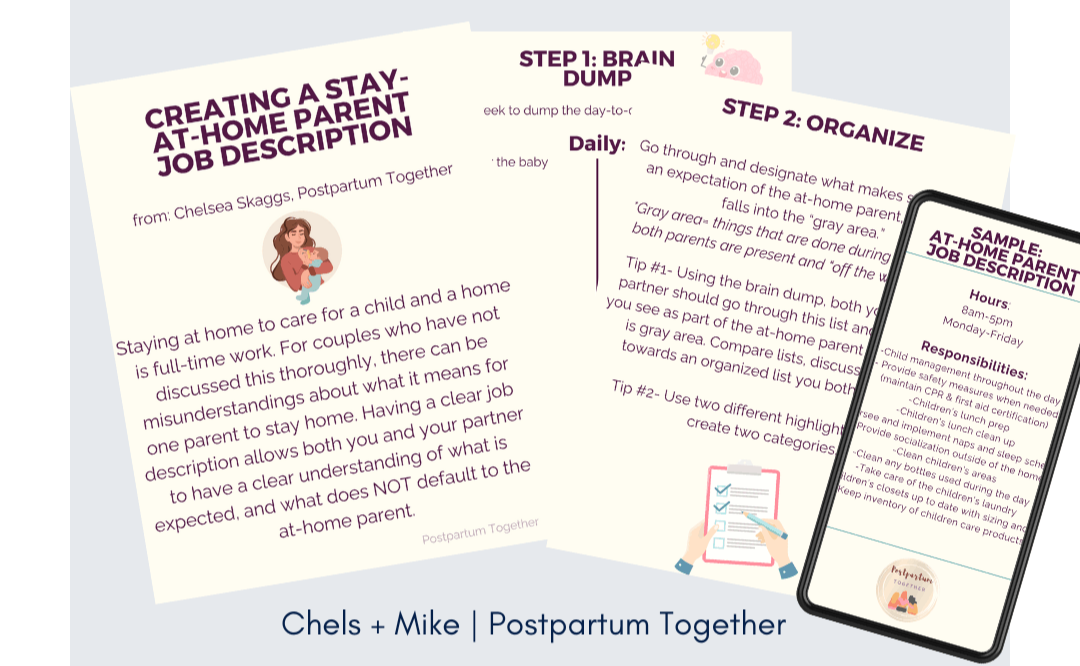
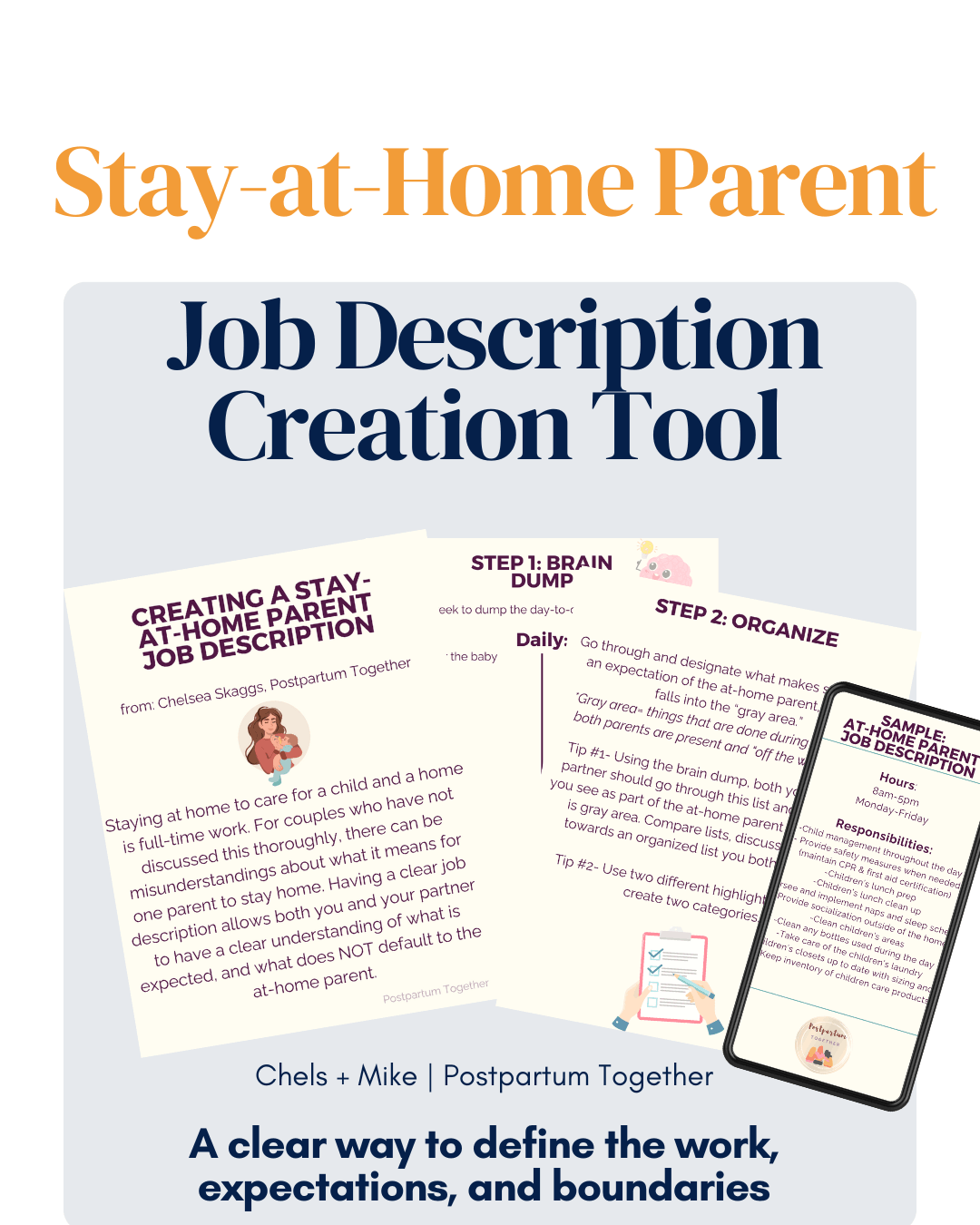
Download the Stay-at-Home Parent Job Description Guide Here!
The Skills You’re Building (Even If No One Says It)
One of the biggest mindset shifts?
You are not “just staying home.”
You are developing real, transferable skills every single day.
Skills you gain as a stay-at-home mom:
Time management
You’re running an entire household on unpredictable schedules.Negotiation
With toddlers, partners, and life in general.Prioritization
Deciding what actually matters when everything feels urgent.Crisis management
Handling meltdowns, chaos, and constant curveballs.Creativity
Making things work with limited time, energy, and resources.
These are not small things.
These are leadership-level skills.
And recognizing that changes how you show up in your role—and how you advocate for support.
Why This Matters for Your Relationship
Without clarity, most couples fall into this pattern:
One person carries the mental load
The other “helps”
Resentment builds
Communication breaks down
A job description interrupts that.
It creates:
Shared understanding
Visible workload
Better conversations
More balanced responsibility
This is how you move from:
👉 “Why do I have to do everything?”
to
👉 “We’re a team.”
How to Create Your Stay-at-Home Mom Job Description
Start simple.
Step 1: Brain dump everything
Write down:
Daily tasks
Weekly tasks
Mental responsibilities
Emotional labor
Step 2: Identify categories
Split into:
Your primary role
Shared responsibilities (“gray areas”)
Step 3: Define working vs shared time
What falls under:
Your “on the clock” time
Both of you outside of that
Step 4: Have the conversation
Not:
👉 “I do everything”
But:
👉 “Here’s what I’m carrying. Let’s rebalance this.”
A Few Shifts That Make This Work
From experience and coaching:
You will need to let go of some control
Your partner will likely do things differently
That does NOT mean they’re doing them wrong
Appreciation and ownership can coexist
You are allowed to have time that is yours
FAQ
Why are stay-at-home moms so exhausted?
Because they carry both the physical work and the invisible mental load of managing a home and family.
Is being a stay-at-home mom harder than a job?
Many moms say yes—because there are no clear boundaries, breaks, or expectations.
How do I explain what I do all day?
Write it down. When your partner sees the full scope, the conversation changes.